Showing posts with label tube amplifier power transformer. Show all posts

Friday, December 19, 2025

Unwinding the Mystery: Why Inner Transformer Windings Have Lower DC Resistance

Unwinding the Mystery: Why Inner Transformer Windings Have Lower DC Resistance


Published by IWISTAO

An Intriguing Observation for the Tube Amp Enthusiast

For anyone who has delved into the world of building, repairing, or simply admiring tube amplifiers, the power transformer is the unsung hero. It's the heart of the amplifier, providing the critical high voltages that bring the vacuum tubes to life. When examining the specifications or taking measurements of a high-voltage secondary winding, a curious detail often emerges: the DC resistance (DCR) is not uniform. Specifically, if a winding is center-tapped or has multiple taps, measurements reveal that the inner sections of the coil have a lower DCR than the outer sections.

This might seem counterintuitive at first. If a high-voltage winding is specified as, for example, 300-0-300V, one might assume that the two 300V sections are identical mirror images. While they have the same number of turns to produce the same voltage, their physical properties differ. This blog post will unravel this fascinating phenomenon, explaining the simple yet profound geometric and physical principles at play.


Back to Basics: What is DC Resistance?

Before we dive into the transformer's core, let's quickly refresh our understanding of electrical resistance. The DC resistance of a wire is determined by a fundamental formula:

R = ρ * (L / A)

Where:

  • R is the total resistance in Ohms (Ω).
  • ρ (rho) is the resistivity of the material, a constant for a given material like copper at a specific temperature.
  • L is the total length of the wire.
  • A is the cross-sectional area of the wire (related to its gauge or thickness).

For a continuous winding in a transformer, both the material (copper) and the wire gauge (cross-sectional area A) are typically constant. Therefore, the only variable that can significantly change the resistance R is the total length of the wire, L. This is the key to solving our puzzle.


IWISTAO 175W Tube Amplifier Power transformer 300VX2 5V Dual 3.15VX2 Silicon Steel Sheet OFC Wire


The Geometry of the Winding: It's All About the Path

A transformer winding isn't just a random jumble of wire. It's a highly organized structure, with wire wound in precise layers around a central form called a bobbin, which itself fits over the transformer's iron core. The high-voltage secondary is typically wound on top of the primary winding and any low-voltage filament windings.


The Concentric Layer Effect

Imagine runners on a multi-lane circular track. To complete one lap, the runner in the innermost lane travels a shorter distance than the runner in the outermost lane. The same principle applies directly to transformer windings.

The first layer of the high-voltage winding is wound directly onto the bobbin (or over the insulation of the layer beneath it). Let's say this first layer has a certain circumference. To start the second layer, the wire is wound on top of the first. This new layer now has a larger diameter—the original diameter plus twice the thickness of the wire from the layer below. Consequently, each single turn in this second layer is slightly longer than a turn in the first layer.

Conceptual diagram: Each successive layer of wire (Layer 2, Layer 3) has a larger circumference than the one inside it (Layer 1), meaning each turn is longer.

This effect compounds with every successive layer. The outermost layer of the winding has the largest diameter and therefore the longest length per turn. This concept is known in transformer design as the Mean Length per Turn (MLT). The MLT for the outer layers is significantly greater than the MLT for the inner layers.


A Practical Example: The Center-Tapped Winding

Let's consider our 300-0-300V high-voltage secondary. This is typically constructed as one continuous winding with a tap at the halfway point in terms of turns count.

  1. Inner Half (First 300V section): The winding process starts from one end. The wire is wound for 'N' turns, forming the inner layers of the coil. At this point, a wire (the center tap) is brought out.
  2. Outer Half (Second 300V section): The winding continues for another 'N' turns, using the same wire, to form the outer layers of the coil, finishing at the other end of the winding.

Both sections have the exact same number of turns ('N'), which is why they produce the same voltage. However, the first half of the winding occupies the inner layers with a smaller MLT. The second half occupies the outer layers with a larger MLT. Since the total length L of the wire is the number of turns multiplied by the average MLT for that section, the outer half of the winding is physically longer than the inner half.

Referring back to our resistance formula, R = ρ * (L / A), since L is greater for the outer winding, its DC resistance R will also be greater. It's a direct consequence of the physical space the winding occupies.


Why Does This Matter? Practical Implications

While this difference in DCR might seem like a minor academic point, it has real-world consequences for the performance and design of a tube amplifier.

1. Voltage Regulation and Sag

Under load, current flows through the high-voltage winding. This current causes a voltage drop across the winding's internal resistance (an effect described by Ohm's Law, V = IR). Because the outer winding has a higher DCR, it will experience a slightly larger voltage drop than the inner winding for the same amount of current. This contributes to what is known as "voltage sag," where the B+ supply voltage decreases as the amplifier is driven harder. In push-pull amplifiers, this slight imbalance can be a factor in the overall circuit symmetry, although it's often considered a secondary effect compared to other variables.

2. Thermal Performance

Power dissipated as heat in a resistor is given by the formula P = I²R. The higher resistance of the outer winding means it will dissipate slightly more heat than the inner winding when the amplifier is operating. Transformer designers must account for this differential heating to ensure the transformer operates within safe temperature limits and to prevent long-term degradation of the wire's insulation. The outer layers are also better positioned to dissipate heat to the surrounding environment, which helps to mitigate this effect.

3. Design and Manufacturing Considerations

Transformer winders are well aware of this geometric reality. It's a fundamental aspect of their craft. The DCR specification on a datasheet often provides a range or an average value, but a careful measurement will always reveal this inner/outer difference. For ultra-high-precision applications, complex winding techniques like sectional or interleaved windings can be used to balance not just resistance, but also capacitance and leakage inductance, though for most tube amp power transformers, a simple layered winding is standard.


Conclusion: An Elegant Consequence of Geometry

The mystery of why the inner part of a high-voltage winding has a lower DC resistance than the outer part is solved not by complex electrical theory, but by simple, elegant geometry. The concentric layering of wires on a bobbin dictates that outer turns must travel a longer path than inner turns.

For the same number of turns, a longer path means a longer total wire length, and thus, a higher resistance. This subtle detail is a perfect example of how fundamental physical principles manifest in the components we use every day. It's a testament to the intricate engineering behind even the most "basic" components and a reminder for the dedicated audio enthusiast that in the pursuit of perfect sound, every detail matters.


References

Wednesday, September 10, 2025

A DIY Guide: Building a Power Transformer for an EL34B Push-Pull Tube Amplifier

A DIY Guide: Building a Power Transformer for an EL34B Push-Pull Tube Amplifier

A DIY Guide: Building a Power Transformer for an EL34B Push-Pull Tube Amplifier

  • Published by IWISTAO

    Introduction: The Unsung Hero of Your Tube Amp

    In the pantheon of high-fidelity audio components, the vacuum tube amplifier holds a place of reverence. Its warm, rich, and dynamic sound is often attributed to the glowing tubes and the meticulously crafted output transformers. Yet, hidden within the chassis, lies a component of equal, if not greater, importance: the power transformer. This component is the silent, steadfast heart of the amplifier, providing the lifeblood—the electrical energy—that every other part of the circuit depends on. Without a robust, well-designed power transformer, even the most exotic tubes and sophisticated circuits will fail to perform.

    This article provides a comprehensive, step-by-step guide for the advanced DIY audio enthusiast on the intricate process of designing, calculating, and constructing a power transformer from scratch. We will embark on a journey from theoretical principles to hands-on craftsmanship, culminating in a custom-built transformer tailored for a classic stereo EL34B push-pull amplifier. This is not a project for the faint of heart, but for those willing to invest the time and diligence, the rewards are immeasurable.

    The Role of the Power Transformer

    At its core, a transformer is a simple device that uses the principle of magnetic induction to transfer electrical energy from one circuit to another without a direct connection . In a tube amplifier, the power transformer's primary function is to take the standard AC mains voltage (e.g., 120V or 230V) and convert it into several different AC voltages required by the amplifier's circuitry. These typically include:

    • A High-Voltage (B+) Secondary: This winding provides a high AC voltage (e.g., 300-500V) which, after being rectified and filtered, becomes the high-voltage DC supply (B+) for the plates and screen grids of the vacuum tubes.
    • Low-Voltage Filament (Heater) Windings: Vacuum tubes require a low voltage (commonly 6.3V or 5V) to heat their cathodes, enabling electron emission. The power transformer provides one or more of these low-voltage, high-current windings.
    • A Rectifier Filament Winding: If a tube rectifier is used (as in our example), it will require its own specific filament voltage, separate from the other tubes.

    It is crucial to distinguish the power transformer from the output transformer. While both operate on similar principles, their roles are distinct. The power transformer works at a fixed line frequency (50/60Hz) and is concerned with power delivery. The output transformer, conversely, must handle the entire audio frequency spectrum (20Hz-20kHz) and is responsible for impedance matching between the high-impedance output tubes and the low-impedance speakers .

    Why Build Your Own?

    In an age of readily available commercial components, why undertake the complex task of building a power transformer? The motivations are compelling for the dedicated enthusiast:

    1. Uncompromising Customization: Commercial transformers are built to general specifications. Building your own allows you to create a transformer perfectly matched to the unique voltage and current demands of your specific amplifier design, optimizing performance and efficiency.
    2. Superior Quality: The DIY route grants you complete control over material selection. You can choose premium-grade silicon steel for the core, high-purity copper wire, and superior insulation materials, often exceeding the quality of off-the-shelf units, especially those in lower price brackets .
    3. The Pursuit of Knowledge: The process of designing and winding a transformer demystifies a critical component of audio electronics. It provides a profound understanding of electromagnetic principles and their practical application, a level of insight that cannot be gained from simply assembling a kit.
    4. The Ultimate Satisfaction: There is a unique and deep satisfaction in listening to an amplifier powered by a core component you have crafted with your own hands, from raw materials to a finished, functional work of art.

    However, this journey is not without its challenges. It demands patience, precision, and an unwavering commitment to safety. As one DIY audio forum member noted, transformer design is a "highly complex" field not recommended for complete novices .

    Prerequisites & Safety Warning

    Before proceeding, it is essential to acknowledge the gravity of this undertaking. This is an advanced project that assumes a solid foundation in electronics theory, proficiency with calculations, and practical skills in soldering and assembly.

    DANGER: HIGH VOLTAGE. A tube amplifier's power supply operates at voltages that are extremely dangerous and can be lethal. The voltages present in a power transformer, both during testing and in operation, can cause severe injury or death. All testing and handling must be performed with extreme caution, using appropriate safety equipment and procedures (such as a dim-bulb tester and a variac). If you are not completely confident in your knowledge of high-voltage safety protocols, **DO NOT ATTEMPT THIS PROJECT.** Your safety is paramount.

    Part 1: The Blueprint - Designing and Calculating Your Transformer

    The success of a DIY transformer hinges entirely on the meticulous work done before a single wire is wound. The design and calculation phase is the blueprint that dictates every subsequent step. A mistake here will, at best, result in a poorly performing transformer; at worst, it can lead to catastrophic failure and a significant safety hazard. In this section, we will use a concrete example to walk through the process: designing a power transformer for a stereo push-pull amplifier.

    The Goal: From Circuit Needs to Transformer Specs

    A power transformer is never designed in isolation. Its specifications are a direct reflection of the demands of the amplifier circuit it is intended to power . Therefore, the first step is always to define the amplifier's architecture.

    Our Example Project: A stereo, Class A/B push-pull amplifier.
    • Power Stage: 4 x EL34B vacuum tubes (two per channel).
    • Preamp/Driver Stage: 2 x 12AX7 vacuum tubes (one per channel, serving as input gain and phase splitter).
    • Rectification: 1 x 5U4G tube rectifier for the B+ supply.

    Our goal is to translate the power requirements of these components into a concrete set of specifications for our transformer's primary and secondary windings.

    Step 1: Determine Power Requirements (The "Why")

    We must calculate the voltage and current required by each part of the circuit. This involves consulting tube datasheets and understanding the operating conditions of the amplifier.

    High Voltage (B+) Winding

    This winding supplies the plate and screen grid voltages for all the tubes.

    1. Target DC Voltage (VDC): EL34B datasheets and common push-pull designs suggest a range of operating points. A popular and effective choice for a balance of power and tube longevity is a B+ voltage around 400V DC . However, for our example, let's choose a slightly more conservative target of 350V DC under load. This voltage will be delivered by a full-wave rectifier using a center-tapped secondary winding.
    2. Total DC Current Draw (IDC): We need to sum the quiescent (idle) current of all tubes connected to the B+ supply.
      • Power Tubes (EL34B): In a Class A/B push-pull configuration, a typical idle current per tube is around 70mA to achieve a plate dissipation of 25W at 350V . For four tubes, this is `4 x 70mA = 280mA`.
      • Preamp Tubes (12AX7): A 12AX7 in a typical preamp or phase splitter circuit draws a very small current, around 1.2mA to 2mA per triode section. Since each 12AX7 has two triodes, and we have two tubes, a safe estimate is `2 tubes * 2 sections/tube * 2mA/section = 8mA`.
      • Total DC Current: `280mA (EL34B) + 8mA (12AX7) = 288mA`. We'll round this up to 300mA for a small margin.
    3. Required AC RMS Current (IAC): This is a critical and often misunderstood calculation. For a power supply with a capacitor-input filter (the most common type), the transformer must deliver current in short, high-amplitude pulses to charge the capacitor. This means the RMS current in the secondary winding is significantly higher than the DC load current. A common rule of thumb is that the AC RMS current rating for a full-wave, center-tapped winding should be 1.5 to 1.8 times the DC current . Using a factor of 1.8 for a conservative design: `I_AC = 300mA * 1.8 = 540mA`.
    4. Required AC Voltage (VAC): For a full-wave tube rectifier (like the 5U4G) with a capacitor-input filter, the resulting DC voltage is roughly 1.1 to 1.2 times the AC RMS voltage of one half of the center-tapped secondary, minus the voltage drop across the rectifier tube. The 5U4G has a significant voltage drop, around 50V at this current. So, to get 350V DC, we need: `V_DC ≈ (V_AC * 1.1) - V_drop`. Rearranging: `V_AC ≈ (V_DC + V_drop) / 1.1 = (350V + 50V) / 1.1 ≈ 364V`. We'll round this to 370V AC. Therefore, our B+ winding will be 370V - 0 - 370V.

    Filament (Heater) Windings

    These low-voltage windings power the tube heaters. It's good practice to use separate windings for the power tubes and preamp tubes to prevent noise from the high-current power tube filaments from coupling into the sensitive preamp stages.

    • Power Tube Filament Winding:
      • EL34B Heater: `6.3V @ 1.5A` each .
      • Total for four tubes: `4 * 1.5A = 6.0A`.
      • Specification: 6.3V @ 6.0A. It's wise to add a 20% current margin, so we'll design for `~7.2A`.
    • Preamp Tube Filament Winding:
      • 12AX7 Heater: `6.3V @ 0.3A` each.
      • Total for two tubes: `2 * 0.3A = 0.6A`.
      • Specification: 6.3V @ 0.6A. With margin, we'll design for `~0.75A`.
    • Rectifier Filament Winding:
      • 5U4G Heater: Requires its own dedicated, insulated winding.
      • Specification: 5V @ 3A. With margin, we'll design for `~3.6A`.

    Calculate Total Power (VA Rating)

    The Volt-Ampere (VA) rating is the apparent power of the transformer. We calculate it by summing the VA of each secondary winding.

    • B+ Winding VA: `(370V + 370V) * 0.540A = 740V * 0.540A = 399.6 VA`. Note: We use the full winding voltage and the calculated AC RMS current.
    • Power Tube Filament VA: `6.3V * 7.2A = 45.36 VA`.
    • Preamp Tube Filament VA: `6.3V * 0.75A = 4.73 VA`.
    • Rectifier Filament VA: `5V * 3.6A = 18.0 VA`.

    Total Secondary VA: `399.6 + 45.36 + 4.73 + 18.0 = 467.69 VA`.

    Transformers are not 100% efficient. We must also account for core and copper losses, typically assuming an efficiency of around 90%. Furthermore, a safety margin is crucial to ensure the transformer runs cool and can handle inrush currents when first powered on. A 25-30% overall margin is a good engineering practice.

    Final Required VA Rating: `467.69 VA * 1.25 ≈ 585 VA`. We will design a transformer with a power rating of approximately 600 VA.

    Step 2: Select the Core and Bobbin (The "What")

    The core is the magnetic heart of the transformer. Its size and material dictate the transformer's power handling capacity and efficiency .

    Core Size vs. Power

    The power a transformer can handle is directly related to the cross-sectional area (A) of its core's center leg. A larger core can handle more magnetic flux before saturating, thus enabling higher power transfer. A widely used empirical formula for standard EI laminations at 50/60Hz is:

    A (in cm²) ≈ 1.15 * √P (in VA)

    For our 600 VA transformer:

    A ≈ 1.15 * √600 ≈ 1.15 * 24.5 ≈ 28.18 cm²

    We now need to find a standard EI lamination size that can provide this core area. The core area is the product of the center tongue width and the stack height of the laminations. For example, an EI-120 lamination has a tongue width of 4.0 cm. To get an area of ~28.2 cm², we would need a stack height of `28.2 / 4.0 = 7.05 cm`. So, an EI-120 core with a 70mm stack would be a suitable choice.

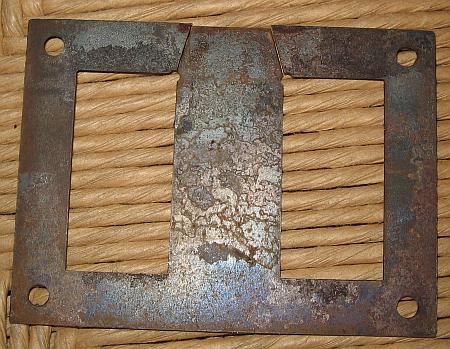
    E-I type transformer lamination
    A typical E-I lamination set, the fundamental building block of many power transformers. The alternating stack of these pieces forms the magnetic core

    Core Material and Type

    For audio applications, especially power transformers, the choice of core material is critical for minimizing losses and unwanted noise.

    • Material: High-quality, grain-oriented (or non-oriented) silicon steel is the standard. A common grade is M6, which has low core loss at 60Hz. The laminations should be thin, typically 0.35mm (0.014 inches), to minimize eddy current losses .
    • Type: While toroidal cores offer lower stray magnetic fields and higher efficiency, traditional EI laminations are more accessible for DIY builders, easier to wind on a bobbin, and embody the classic transformer construction method . We will proceed with an EI core design.

    Bobbin Selection

    The bobbin is the insulating form onto which the wires are wound. It must be chosen to match the core size (EI-120 in our case). Crucially, the bobbin's "window area" must be large enough to physically accommodate all the calculated windings, including the space taken up by insulation. A preliminary check can be done, but the final confirmation often comes after calculating the space each winding will occupy. It's always better to choose a bobbin with a slightly larger window than you think you need.

    Step 3: Calculate the Windings (The "How")

    Now we translate our voltage requirements into the physical number of turns of wire for each winding.

    Turns Per Volt (TPV)

    The fundamental transformer equation relates voltage, frequency, core area, flux density, and the number of turns:

    V = 4.44 * N * f * A * B

    Where: V = Voltage (Volts), N = Number of turns, f = Frequency (Hz), A = Core Area (m²), B = Max Flux Density (Tesla).

    We can rearrange this to find the Turns Per Volt (TPV = N/V). For DIY purposes, a simplified and conservative rule of thumb is often used, which implicitly assumes a safe flux density (B ≈ 1.0-1.2 Tesla) for standard silicon steel to avoid core saturation:

    TPV ≈ 45 / Core Area (in cm²)

    Using our calculated core area of 28.18 cm²:

    TPV ≈ 45 / 28.18 ≈ 1.6 Turns Per Volt

    Number of Turns for Each Winding

    Now we apply the TPV to our voltage specifications. It's vital to add a compensation factor (typically 5-10%) to the secondary windings to account for voltage drop (IR drop) under load. We'll use 5%.

    • Primary Winding (assuming 230V mains):
      • Turns = Mains Voltage * TPV = 230V * 1.6 T/V = 368 Turns
    • High-Voltage (B+) Secondary:
      • Turns (per half) = Target Voltage * TPV * 1.05 = 370V * 1.6 T/V * 1.05 = 621.6 Turns
      • We'll use 622 turns for each half. So, the winding will be 1244 turns total, with a tap at 622 turns.
    • Power Tube Filament Secondary:
      • Turns = 6.3V * 1.6 T/V * 1.05 = 10.58 Turns. We'll round up to 11 Turns.
    • Preamp Tube Filament Secondary:
      • Turns = 6.3V * 1.6 T/V * 1.05 = 10.58 Turns. We'll also use 11 Turns.
    • Rectifier Filament Secondary:
      • Turns = 5.0V * 1.6 T/V * 1.05 = 8.4 Turns. We'll use 9 Turns.

    Wire Gauge (AWG/SWG)

    The diameter of the wire for each winding is determined by the current it must carry. A wire that is too thin for its current will overheat, melt its insulation, and cause a short circuit. A common rule for transformer winding is to use a current density of 2.5 to 3.0 Amperes per square millimeter (A/mm²) of wire cross-section.

    We can consult a standard wire gauge table (AWG or SWG) that lists the diameter and cross-sectional area for each gauge number.

    1. Primary Winding: First, calculate the primary current: `I_primary = Total VA / V_primary = 600 VA / 230V = 2.61A`. Using a density of 2.5 A/mm², we need a wire area of `2.61A / 2.5 A/mm² = 1.044 mm²`. This corresponds to approximately 17 AWG wire.
    2. High-Voltage Secondary: The AC RMS current was calculated as 540mA (0.54A). Required area: `0.54A / 2.5 A/mm² = 0.216 mm²`. This corresponds to approximately 24 AWG wire.
    3. Power Tube Filament: Current is 7.2A. Required area: `7.2A / 2.5 A/mm² = 2.88 mm²`. This is a thick wire, corresponding to approximately 12 AWG.
    4. Preamp Tube Filament: Current is 0.75A. Required area: `0.75A / 2.5 A/mm² = 0.3 mm²`. This corresponds to approximately 22 AWG.
    5. Rectifier Filament: Current is 3.6A. Required area: `3.6A / 2.5 A/mm² = 1.44 mm²`. This corresponds to approximately 15 AWG.

    With these calculations complete, we have a full blueprint for our transformer. The next step is to bring it to life.

    Part 2: The Craft - Winding and Assembling the Transformer

    This section transitions from the abstract world of calculations to the tangible, hands-on process of construction. It is a craft that rewards patience, precision, and a methodical approach. The quality of the winding directly impacts the transformer's performance, reliability, and quietness of operation.

    Step 1: Preparation - Materials and Tools

    Gathering all necessary materials and tools before starting is essential for a smooth workflow. A well-organized workspace is a safe workspace.

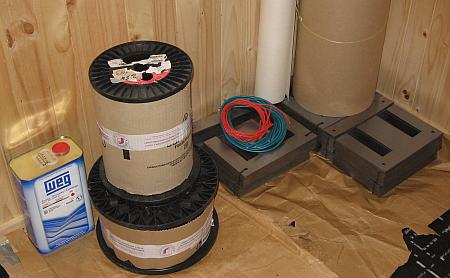
    Materials for transformer winding
    Essential materials for transformer construction: EI laminations, spools of enamelled wire, and insulating varnish

    Materials Checklist:

    • EI Laminations: EI-120, M6 grade, 0.35mm thickness, sufficient for a 70mm stack.
    • Bobbin: One EI-120 bobbin, made of phenolic, Ryton®, or another high-temperature plastic.
    • Enameled Copper Wire: The calculated gauges (12, 15, 17, 22, 24 AWG). Ensure you have enough length for each winding, plus extra.
    • Insulation Paper: Mylar or Nomex paper of various thicknesses. Typically 0.05mm for layer insulation and 0.25mm for inter-winding insulation.
    • Insulation Tape: High-temperature tape such as Kapton or fiberglass-reinforced tape.
    • Lead-out Wires: Flexible, high-temperature insulated wire (Teflon or silicone) of appropriate gauges to connect to the magnet wire ends.
    • Hardware: End bells (clamps) and bolts/nuts suitable for an EI-120 core.
    • Insulating Varnish: A can of air-drying or baking electrical insulating varnish.

    Tools Checklist:

    • Winding Machine: A manual hand-cranked or a slow-speed motorized coil winder with a turns counter is indispensable.
    • Soldering Iron & Solder: For connecting lead-out wires.
    • Wire Strippers/Scraper: To remove enamel from the magnet wire ends.
    • Multimeter: Essential for testing during and after construction.
    • Rubber Mallet: For tapping laminations into place.
    • Safety Gear: Safety glasses are a must.

    Step 2: Bobbin Preparation

    The bobbin provides the structural and insulating foundation for the windings. Proper preparation is key.

    1. Inspect: Carefully inspect the bobbin for any sharp edges or molding flash, especially on the inside corners where the wire will turn. Smooth any imperfections with a small file or sandpaper to prevent damage to the wire's delicate enamel insulation.
    2. Insulate the Core Tube: Wrap the central part of the bobbin (the core tube) with two to three layers of Kapton or Mylar tape. This provides an extra layer of insulation between the windings and the iron core that will eventually be inserted .

    Step 3: Primary Winding

    The primary winding is the first to be wound onto the bobbin. It must be done with the utmost care as it is the foundation for all other windings.

    1. Anchor the Start: Solder a flexible lead-out wire to the start of your primary magnet wire (17 AWG). Be sure to thoroughly scrape the enamel off the magnet wire first to ensure a solid connection. Insulate the solder joint with heat-shrink tubing. Securely anchor this lead-out wire to the bobbin's flange.
    2. Wind the First Layer: Begin winding, ensuring each turn lies flat and tight against the previous one. There should be no gaps or overlaps. This is called a "neat" or "perfect" layer. The tension should be firm but not so tight as to stretch the wire or deform the bobbin.
    3. Insulate Between Layers: Once the first layer is complete, cut a piece of 0.05mm insulation paper to the width of the bobbin window. Wrap one full layer of this paper over the winding, securing it with a small piece of tape. This layer insulation is critical to prevent voltage breakdown between layers .
    4. Continue Winding: Wind the subsequent layers, each in the opposite direction to the last. After every single layer, apply another sheet of insulation paper. Keep a precise count of the turns.
    5. Secure the End: Once you have wound the calculated 368 turns, secure the end of the wire, solder on its lead-out wire, and anchor it to the bobbin flange, ensuring it cannot unravel.

    Step 4: Inter-winding Insulation

    This is arguably the most critical safety step in the entire process. The insulation between the primary (mains voltage) and secondary windings must be robust enough to withstand high voltage potentials and prevent a catastrophic failure.

    Do not cut corners here. A failure of this insulation could connect lethal mains voltage directly to your amplifier's chassis and secondary circuits.

    Wrap at least three to five layers of thicker (e.g., 0.25mm) insulation paper over the entire completed primary winding. Follow this with two to three tightly-wrapped layers of fiberglass or Kapton tape. This creates a formidable dielectric barrier.

    Step 5: Secondary Windings

    The secondaries are wound on top of the insulated primary. A logical order is to wind the high-voltage winding first, followed by the lower-voltage filament windings.

    1. High-Voltage Winding:
      • Start the 24 AWG wire just as you did the primary.
      • Wind the first 622 turns, applying layer insulation after each layer.
      • At the 622nd turn, carefully pull a loop of wire out from the side of the bobbin. This will be your center tap. Secure it well so it doesn't get pulled back in, and protect it with tubing.
      • Continue winding the second 622 turns, maintaining the same winding direction on the bobbin.
      • Finish the winding and attach the final lead-out wire.
    2. More Insulation: After completing the high-voltage winding, apply another heavy layer of inter-winding insulation (3-4 layers of 0.25mm paper) to isolate it from the filament windings.
    3. Filament Windings:
      • These windings use much thicker wire and have very few turns (9-11 in our case). They can be tricky to wind neatly.
      • Wind the 5V rectifier winding first (15 AWG, 9 turns).
      • Apply a layer of insulation.
      • Wind the 6.3V power tube filament winding (12 AWG, 11 turns).
      • Apply a layer of insulation.
      • Wind the 6.3V preamp filament winding (22 AWG, 11 turns).
      • It is good practice to twist the lead-out wires for the filament windings together to help cancel out their magnetic fields and reduce induced hum.

    Step 6: Final Insulation and Core Assembly

    The winding process is complete. The final steps involve protecting the windings and assembling the iron core.

    1. Final Wrap: Wrap the entire finished bobbin with several layers of durable tape (like yellow transformer tape or fiberglass tape) to protect the outer windings from abrasion during core assembly.
    2. Insert Laminations: Begin inserting the EI laminations into the bobbin's core opening. For a power transformer, the core must be fully interleaved with no air gap. This is achieved by inserting the 'E' and 'I' pieces in an alternating pattern. Insert one 'E' from the left, then one 'I' from the right to fill the gap. Then, insert the next 'E' from the right, and its 'I' from the left. Continue this `1x1` alternating pattern .
    3. Stack Tightly: The laminations will be a tight fit. Use a rubber mallet to gently tap them into a tight, uniform stack. The goal is to fit as many laminations as possible to achieve the designed stack height (70mm).
    4. Clamp the Core: Once the core is fully stacked, place the end bells (clamps) over the ends of the stack and secure them with the bolts and nuts. Tighten the bolts firmly and evenly, but do not overtighten to the point where the laminations are bent or distorted, as this can increase core losses and audible hum.

    Step 7: Finishing (Optional but Recommended)

    Varnishing the completed transformer offers several benefits: it helps to mechanically secure the windings and laminations, significantly reducing audible hum or buzz; it improves thermal conductivity, helping heat dissipate from the core; and it protects the transformer from moisture and corrosion .

    The process, known as vacuum pressure impregnation (VPI) in industrial settings, can be approximated by the DIYer:

    1. Pre-heat: Gently warm the transformer in an oven to about 50-60°C to drive out any trapped moisture.
    2. Immerse: While still warm, fully submerge the transformer in a container of electrical insulating varnish. The warmth helps the varnish flow into the smallest crevices. If you have a vacuum chamber, placing the container inside and pulling a vacuum will remove all trapped air bubbles, ensuring complete penetration.
    3. Drip and Cure: After soaking for an hour or more, remove the transformer and hang it to allow excess varnish to drip off.
    4. Bake: Cure the transformer in an oven according to the varnish manufacturer's instructions. This typically involves several hours at a specific temperature (e.g., 8-12 hours at 100-120°C). This process will polymerize the varnish into a hard, solid block.

    The result is a mechanically solid, quiet, and professionally finished transformer, ready for the final and most important phase: testing.

    Part 3: The Verdict - Testing and Verification

    With the transformer fully assembled and cured, the moment of truth arrives. This final stage is not merely a formality; it is a critical safety and quality assurance process. Thorough testing verifies that the transformer has been built correctly, performs to its design specifications, and is safe to install in your amplifier.

    Safety First: The Cardinal Rule

    Before connecting any power, perform a series of "cold" checks with a multimeter. These checks can identify major faults like short circuits or open windings without any risk.

    Reiteration of Warning: All "hot" tests involving mains voltage must be conducted with extreme caution. Always use a dim-bulb tester or a variac (variable autotransformer) to slowly bring up the voltage for the initial power-on. This can prevent catastrophic damage in case of a short circuit. Work with one hand in your pocket to avoid creating a current path across your chest.

    Checklist for a Healthy Transformer

    Follow this sequence of tests methodically. Do not proceed to the next step if a test fails.

    1. Visual Inspection

    Carefully examine the entire transformer. Look for any nicks or scrapes in the wire insulation, loose lead-out wires, signs of arcing, or physical damage to the core or bobbin. Ensure all hardware is tight.

    2. Continuity and DC Resistance (DCR) Check (Cold Test)

    Use a multimeter in resistance (Ohms) mode.

    • Purpose: To verify that each winding is a continuous copper path and to get a baseline DCR reading.
    • Procedure: Measure the resistance between the two lead-out wires of each winding.
      • Primary: Should read a low resistance, typically 5-20 Ω for a transformer this size.
      • High-Voltage Secondary: This has many turns of fine wire, so its resistance will be higher, likely in the 80-150 Ω range from end-to-end. The resistance from each end to the center tap should be almost identical (within 1-2%).
      • Filament Windings: These are few turns of thick wire, so their resistance will be very low, often less than 1 Ω.
    • Expected Result: Each winding should show a stable, non-zero resistance. A reading of infinity (O.L.) indicates a broken wire (open circuit). A reading of zero indicates a dead short.

    3. Isolation Check (Cold Test)

    This is the most important safety check.

    • Purpose: To ensure there is no electrical connection between separate windings or between any winding and the iron core.
    • Procedure: Set your multimeter to its highest resistance range (MΩ). Measure the resistance between:
      1. The primary and the core.
      2. The secondary HV winding and the core.
      3. The primary and the secondary HV winding.
      4. The primary and each filament winding.
      5. The HV secondary and each filament winding.
    • Expected Result: All measurements must read infinite resistance (O.L. on a digital meter). Any measurable resistance, no matter how high, indicates a critical insulation failure. The transformer is unsafe and must not be powered on. A proper insulation tester (Megger) would show a resistance well above 500 MΩ at 500V.

    4. No-Load Test (Hot Test - Use Extreme Caution)

    This is the first time the transformer will see mains voltage.

    • Purpose: To verify the turns ratio is correct by measuring the output voltages and to check for excessive no-load current, which would indicate a shorted turn or core problem.
    • Procedure:
      1. Place the transformer on a non-conductive surface. Ensure no leads are touching.
      2. Connect the primary winding to your mains outlet **through a dim-bulb tester**. A 60W or 100W incandescent bulb is suitable.
      3. Power on. The bulb should flash brightly for an instant (as the core magnetizes) and then settle to a very dim glow. If the bulb stays bright, you have a short circuit. Immediately power off and investigate.
      4. If the bulb is dim, it is safe to proceed. Use your multimeter in AC Volts mode to carefully measure the voltage across each secondary winding.
      5. Measure the no-load primary current using a clamp meter or another multimeter in series (AC Amps mode). This is best done after removing the dim-bulb tester and using a variac to apply the exact rated voltage.
    • Expected Result:
      • Voltages: The measured secondary voltages will be slightly higher (typically 5-10%) than the design voltage because there is no load to cause a voltage drop. For our design: HV secondary might be ~780-810V end-to-end, filaments ~6.6-6.9V, etc.
      • No-Load Current: The primary current should be very low, typically less than 100mA for a well-made transformer of this size. High no-load current indicates a problem.

    5. Load Test (Advanced Hot Test)

    This test simulates the transformer's real-world operating conditions.

    • Purpose: To check voltage regulation (how much the voltage drops under load) and thermal stability.
    • Procedure:
      1. Connect high-power resistors of the appropriate value to each secondary winding to draw the designed load current. (e.g., for the 6.3V @ 7.2A winding, you'd need a `R = V/I = 6.3/7.2 = 0.875 Ω` resistor rated for at least `P = V*I = 6.3*7.2 = 45W`). This requires specialized and expensive equipment.
      2. Power on the transformer and let it run for an extended period (30-60 minutes).
      3. Periodically measure the secondary voltages to see how much they have "sagged" from their no-load values.
      4. Carefully monitor the transformer's temperature with an infrared thermometer or by touch (with extreme caution, and only after powering off).
    • Expected Result:
      • Voltage Regulation: The secondary voltages should drop but remain stable and close to the design targets (e.g., within 5-7%).
      • Temperature: The transformer will get warm. A temperature rise of 40-60°C above the ambient room temperature is normal for a transformer running at full load. It should be warm or hot to the touch, but not so hot that it burns you or smells of burning insulation.

    If your transformer passes all these tests, you can have a high degree of confidence in its quality and safety. You have successfully crafted the heart of your amplifier.

    Practical Guide: Transformer for a Stereo EL34B Amplifier

    This section consolidates the design parameters and specifications from our running example into a quick-reference format. This serves as a practical summary for a builder undertaking this specific project.

    1. Design & Calculation Summary

    • Amplifier Type: Stereo Push-Pull EL34B Amplifier (4x EL34B, 2x 12AX7, 1x 5U4G)
    • Mains Input: `230V AC, 50Hz` (or `120V, 60Hz` as required, primary turns must be recalculated)
    • Calculated Total Power: `~600 VA` (including safety margin)
    • Selected Core: `EI-120`, Stack Thickness `70mm` (Core Area `~28 cm²`)
    • Calculated Turns Per Volt (TPV): `~1.6 T/V`

    2. Materials & Winding Specification

    Category Item Specification
    Core EI Lamination EI-120, Stack 70mm, Material: M6 / 0.35mm Silicon Steel
    Bobbin Bobbin for EI-120 Phenolic or high-temperature plastic (e.g., Ryton®)
    Magnet Wire Enameled Copper Wire Primary: 17 AWG, HV: 24 AWG, Filaments: 12, 15, 22 AWG
    Insulation Paper & Tape 0.05mm Nomex/Mylar for layer insulation, 0.25mm for inter-winding, Kapton/Fiberglass tape

    Winding Name Voltage / Current Wire Gauge (AWG) Turns (Approx.) Tapping Point Notes
    Primary 230V 17 AWG 368 Turns 115V (opt.) Wind first, closest to the core.
    High Voltage (B+) 370V - 0 - 370V @ 540mA AC 24 AWG 622 + 622 Center Tap Requires robust insulation before and after.
    Filament 1 (Rectifier) 5V @ 3.6A 15 AWG 9 Turns N/A Must be a separate, well-insulated winding.
    Filament 2 (Power) 6.3V @ 7.2A 12 AWG 11 Turns N/A Heavy gauge wire. Keep leads short and twisted.
    Filament 3 (Preamp) 6.3V @ 0.75A 22 AWG 11 Turns N/A Keep leads twisted to reduce hum pickup.

    3. Testing & Verification Checklist

    Test Item Procedure Expected Result / Standard
    DC Resistance Use a multimeter to check resistance of each winding. Primary: ~5-15 Ω, HV: ~100-150 Ω, Filaments: <1 Ω. No continuity between separate windings or to core.
    Insulation Resistance Measure resistance between windings and between windings/core. > 500 MΩ @ 500V DC (using an insulation tester). Infinite on a standard multimeter.
    No-Load Voltage Apply rated voltage to primary. Measure all secondary voltages. Voltages should be 5-10% higher than rated (e.g., HV ~780-810V end-to-end). No-load primary current < 100mA.
    Load Test Connect specified resistive loads. Run for 30 mins. Voltage drop should be <; 7%. Core temperature stable and not exceeding 60°C above ambient. No audible buzzing.

    Reference

    [2]
    El34 El34b 10w Single-ended Class A Tube Amplifier Power ...
    https://www.aliexpress.com/i/4000832820177.html
    [4]
    Output transformers and push-pull stages. - tubes
    https://tubes.njunis.net/?p=398&lang=en
    [5]
    [6]
    Chapter 6: Step by step design of a push-pull vacuum tube amplifier
    https://www.vtadiy.com/book/chapter-6-step-by-step-design-of-a-push-pull-tube-amplifier/
    [8]
    [PDF] EL34 Triple C-Core Monoblock "The Artiste" - ANK Audio Kits
    https://ankaudiokits.com/ankmanuals/EL34%2040W%20Monoblock%20V%203.03.pdf
    [10]
    Loadline calculator for power stages with reactive load - VTADIY
    https://www.vtadiy.com/loadline-calculators/power-stage-calculator/
    [12]
    Tube Power Supply : 15 Steps (with Pictures) - Instructables
    https://www.instructables.com/Tube-Power-Supply/
    [13]
    Power Supply Design for Vacuum Tube Amplifiers
    https://diyaudioprojects.com/Technical/Tube-Power-Supplies/
    [15]
    How to calculate push-pull impedence? - EL34 World
    https://el34world.com/Forum/index.php?topic=22540.0
    [16]
    [17]
    Practical Transformer Winding - Ludens.cl
    https://ludens.cl/Electron/trafos/trafos.html
    [18]
    [20]
    Calculations For Design Parameters of Transformer | PDF - Scribd
    https://www.scribd.com/document/421833913/Calculations-for-Design-Parameters-of-Transformer
    [24]
    Transformer Windings: Structures, Manufacturing and Applications
    https://shinenergy.net/transformer-windings-structures-manufacturing-and-applications/
    [25]
    How to Improve Energy Efficiency of Transformers with Insulation
    https://guerzonisrl.it/how-to-improve-energy-efficiency-with-insulation/
    [26]
    Tube Power Supply : 15 Steps (with Pictures) - Instructables
    https://www.instructables.com/Tube-Power-Supply/
    [27]
    How to test an audio transformer - All About Circuits Forum
    https://forum.allaboutcircuits.com/threads/how-to-test-an-audio-transformer.168870/
    [28]
    Tube Amp Power Transformer Current Draw Calculator
    https://thesubjectmatter.com/calcptcurrent.html
    [29]
    An Experiment in Transformer Rewinding - Instructables
    https://www.instructables.com/An-experiment-in-transformer-rewinding/
    [31]
    Output Transformer formula? - The Amp Garage
    https://ampgarage.com/forum/viewtopic.php?t=37152
    [32]
    Amplifier Power Transformer Calculations: B+ Current | PDF - Scribd
    https://www.scribd.com/document/536457766/Amp
    [33]
    Practical Transformer Winding - Ludens.cl
    https://ludens.cl/Electron/trafos/trafos.html
  • Tuesday, April 22, 2025

    Advantages and Disadvantages of Using ED Double C-Type Transformer Cores for Transformers in Tube Amplifier

    Analysis of the Advantages and Disadvantages of Using ED Double C-Type Transformer Cores for Transformers in Tube Amplifiers


    The choice of transformer cores significantly impacts tube amplifier performance. This article analyzes the pros and cons of using ED double C - type cores in power and output transformers for tube amplifiers.


    Advantages of ED Double C-Type Cores for Power Transformers

    High Magnetic Permeability

    With high magnetic permeability, these cores conduct magnetic flux efficiently. This reduces losses, boosts power delivery, and enhances overall power transformer efficiency. Stable power supply is thus ensured for consistent audio output.

    Low Magnetostriction

    ED double C - type cores have low magnetostriction, minimizing mechanical vibrations and noise in the transformer. This results in a cleaner audio signal, free from unwanted hum, which is crucial for tube amplifier power transformers.

    Compact Design

    Compared to traditional cores, their unique C - shaped structure allows for a more space - efficient magnetic circuit. This enables building smaller yet powerful power transformers, beneficial for space - limited tube amplifier projects.

    Customization Flexibility

    Builders can easily adjust winding parameters like turns and wire gauge. This flexibility optimizes power transformer performance, meeting various power requirements from high - power to low - power tube amplifier designs.


    Advantages of ED Double C-Type Cores for Output Transformers

    Excellent Frequency Response

    These cores endow output transformers with a wide and flat frequency response. Their high magnetic permeability and low reluctance enable handling of both low and high frequencies with minimal phase shift and distortion, leading to a more natural sound.

    Low Distortion

    The cores' uniform magnetic properties and low magnetostriction maintain a linear magnetic field. This reduces harmonic and intermodulation distortion, preserving the integrity of the audio signal for accurate sound reproduction in tube amplifiers.

    High Power Handling Capability

    Despite their compact size, they can handle high power levels in output transformers. Their robust design allows for effective heat dissipation, preventing saturation and ensuring reliable operation in various tube amplifier applications.


    Disadvantages of ED Double C-Type Cores for Power Transformers

    Higher Cost

    Manufacturing these cores is more intricate, involving precision machining of C - shaped pieces. The use of high - quality materials also contributes to a higher cost compared to other core materials, such as silicon steel laminations. This can be a barrier for budget - conscious DIY builders.

    Challenging Winding Process

    The narrow gap between C - shaped pieces makes winding more difficult than with traditional cores. Special configuration of the winding machine may be needed, and careful handling is required to ensure even winding and proper insulation, deterring novice builders.

    Sensitivity to Magnetic Fields

    ED double C - type cores are more sensitive to external magnetic fields. In a tube amplifier chassis with multiple magnetic components, this can cause magnetic interference and increased noise. Additional shielding measures, which add cost and complexity, may be necessary.


    Disadvantages of ED Double C-Type Cores for Output Transformers

    Limited Availability

    In some regions, they may be less available than common core types. This makes it hard for DIY builders to source the right size or specification, leading to longer lead times and higher shipping costs.

    Complex Matching Requirements

    Achieving optimal impedance match is more complex due to their unique magnetic characteristics. Builders need to carefully calculate winding ratios, which requires electrical engineering knowledge and may involve trial - and - error, posing a challenge for less experienced builders.

    Susceptibility to Saturation

    Under certain conditions like high current or low - frequency signals, these cores in output transformers are more prone to magnetic saturation. Designers must carefully select core size and winding parameters to prevent this, which may limit design flexibility.

    So, ED double C - type transformer cores offer advantages like high magnetic permeability and low distortion. However, they also have drawbacks such as high cost and complex winding. Builders should weigh these factors based on their project requirements, budget, and technical skills. With proper planning, these cores can be a good choice for high - performance tube amplifier designs.


    Here, IWISTAO provide this kind of ED double C core to meet DIYers's requirement, its size is from 66*30 to 133*70, you may select one of them based on your requested.


    IWISTAO Double C Transformer Core Kit For Tube Amplifier Power and Output Transformer Multiple Sizes HIFI Audio DIY