Sunday, October 5, 2025

The Magic Mouse Dock: An Essential Fix for Apple's Flawed Beauty

The Magic Mouse Dock: An Essential Fix for Apple's Flawed Beauty

Published by IWISTAO

Table of Contents

  • The Core Conundrum: Apple's Design-Driven Dilemma
    • The Ergonomic "Nightmare"
    • The Infamous Charging Flip
  • The Rise of the Dock: Third-Party Solutions to the Rescue
    • Solution 1: Ergonomic Bases for a Better Grip
    • Solution 2: Charging Docks to "Cut the Flips"
  • Beyond the Dock: Other Ways to Enhance Your Magic Mouse Experience
    • Choosing the Right Surface: The Mousepad Matter
    • Unleashing Its Power: Software Customization
  • The Verdict: Is a Magic Mouse Dock Worth It?

Apple's Magic Mouse is an icon of industrial design. With its seamless multi-touch surface and minimalist aesthetic, it perfectly embodies the company's ethos of simplicity and elegance. Yet, for over a decade, it has remained one of Apple's most polarizing products. Users often find themselves caught in a love-hate relationship, admiring its beauty while lamenting its practical flaws.

Apple Magic Mouse
The Magic Mouse, known for its low-profile and minimalist design
The Magic Mouse is often criticized for its lack of ergonomics, causing discomfort like palm soreness and difficulty clicking due to its aesthetic-focused flat design. - Solumics Blog

This paradox—beautiful form at the expense of comfortable function—has spawned a thriving market of third-party accessories. Chief among them are "docks" or "bases," clever add-ons designed to address the mouse's two most significant pain points: its uncomfortable grip and its notoriously inconvenient charging method. This article explores these solutions and asks the ultimate question: can a simple dock truly fix Apple's flawed masterpiece?

The Core Conundrum: Apple's Design-Driven Dilemma

To understand why docks exist, we must first dissect the fundamental issues with the Magic Mouse's design. The criticisms, echoed across countless forums and reviews, consistently target two key areas.


The Ergonomic "Nightmare"

The most persistent complaint is about ergonomics. Described by many as an "ergonomic nightmare,"; the mouse's low, flat profile offers virtually no palm support. This forces users into an unnatural "claw grip," which can lead to wrist strain and discomfort during prolonged use . The sharp edges further exacerbate the issue, making it difficult to hold comfortably.

However, defenders of the Magic Mouse argue that it was never meant for a traditional palm grip. Instead, its design encourages a fingertip grip, prioritizing the use of its multi-touch surface for gestures like scrolling and swiping. As one analysis points out, "the entire Magic Mouse is a硕大的滚轮 (a huge scroll wheel)," best operated with light finger movements rather than whole-hand maneuvering . While this may be true, it doesn't negate the discomfort felt by a large portion of users.

The Infamous Charging Flip

The second major flaw is the placement of the charging port on the mouse's underside. This design choice, which has persisted from the Lightning version to the latest USB-C model, renders the mouse completely unusable while it's charging. This forces users to flip the device over, creating downtime that feels antithetical to a seamless workflow. It has been widely ridiculed as one of Apple's most baffling design decisions.

The Rise of the Dock: Third-Party Solutions to the Rescue

In response to these widespread issues, the accessory market has delivered a variety of docks and bases. These solutions can be broadly categorized into two types: those that fix the ergonomics and those that fix the charging.

Solution 1: Ergonomic Bases for a Better Grip

Ergonomic bases are essentially shells or platforms that the Magic Mouse snaps into. Their goal is to transform the flat puck into a more traditionally shaped mouse with proper palm support.

  • Full-Body Cases: Products like the Solumics Case and the MouseBase are designed to elevate and tilt the mouse, creating a more natural hand posture. They add bulk and a curved surface for your palm to rest on, significantly reducing strain without impeding the top surface's gesture controls.
  • Side Grips: A simpler solution comes in the form of adhesive grips like MagicGrips. These attach to the sides of the mouse, providing a wider and more comfortable surface for your thumb and fingers to hold onto, making the device easier to control .
  • Aesthetic Options: Many manufacturers on platforms like JD.com and TaoBao offer bases made from various materials, including plastic, silicone, and even premium woods like walnut, allowing users to match their desk setup.


Magic Mouse Dock by IWISTAO
Magic Mouse paired with various colored bases by 3D print, designed to improve ergonomics

Solution 2: Charging Docks to "Cut the Flips"

To solve the charging problem, a different category of docks offers a more elegant way to power up the mouse. Instead of fumbling with a cable, you simply place the mouse on the dock.

  • Upright Charging Stands: Brands like UNIQ with its Nova dock offer a simple and clean solution. You coil your existing charging cable inside the dock and place the mouse on it to charge. Their motto says it all: "Say goodbye to mouse flips."
  • Wireless Charging Adapters: Some innovative bases, such as those found on Amazon, not only improve ergonomics but also add Qi wireless charging capabilities. You place the mouse in the base, and then the entire unit can be placed on a standard wireless charger.
  • Magnetic Docks: With the advent of the USB-C Magic Mouse, new solutions like the Geekria Charging Station have emerged. These use a small magnetic connector, allowing for a quick and satisfying snap-on charging experience.
A charging dock allows the Magic Mouse to be charged in an upright position


Beyond the Dock: Other Ways to Enhance Your Magic Mouse Experience

While docks are a major part of the solution, improving your Magic Mouse experience doesn't stop there. Two other areas are worth considering: the surface you use it on and the software that powers it.

Choosing the Right Surface: The Mousepad Matter

The Magic Mouse's two plastic feet, or "glide rails," can behave very differently depending on the surface. Many users report that traditional cloth mousepads create too much friction, making the mouse feel sluggish and difficult to move precisely.

For optimal performance, a hard, smooth surface is often recommended. According to reviews and user tests, materials like polycarbonate, aluminum, or finely finished plastic provide the best experience. Products like the Razer Sphex V3 (a thin polycarbonate pad) or hard aluminum mousepads are praised for allowing the Magic Mouse to glide effortlessly .

A Magic Mouse on a silver, hard-surface mousepad, which can improve gliding performance


Unleashing Its Power: Software Customization

One of the biggest missed opportunities of the Magic Mouse is that its native software support is surprisingly limited. It supports only one and two-finger gestures out of the box. However, with third-party applications like BetterTouchTool, you can unlock its true potential. This powerful utility allows you to create custom triggers for three-finger swipes, four-finger taps, and a vast array of other gestures, transforming the Magic Mouse into a productivity powerhouse that rivals even the Magic Trackpad.

The Verdict: Is a Magic Mouse Dock Worth It?

After years of user feedback and third-party innovation, it's clear that the Magic Mouse is a device that many people want to love. A dock or base can be the bridge that closes the gap between its aesthetic appeal and its practical usability.

A dock is likely worth it if:

  • You love the multi-touch gestures for scrolling and navigation but suffer from hand or wrist discomfort.
  • You are frequently frustrated by having to stop work to charge your mouse.
  • You are committed to the Apple ecosystem and want to improve an existing accessory rather than replace it.

However, you might want to skip it and consider an alternative if:

  • You prioritize ergonomics above all else. A dedicated ergonomic mouse like the Logitech MX Master 3S will likely provide more comfort.
  • You dislike the idea of adding bulk to a minimalist device.
  • The extra cost of a quality dock on top of an already expensive mouse feels unjustified.

Ultimately, the Magic Mouse dock is a testament to user ingenuity. It's a fix for a problem that Apple itself has been unwilling to solve. For many, it's the missing piece that transforms the Magic Mouse from a beautiful but flawed accessory into a genuinely great tool. Until Apple decides to release a "Magic Mouse 3" that addresses these long-standing issues, these docks remain the best upgrade a Magic Mouse owner can get.


Reference

[1]
Is the Magic Mouse Worth It? A Comprehensive Review
https://softhandtech.com/is-magic-mouse-worth-it/
[2]

Wednesday, October 1, 2025

From Clicks to Crescendos: Your Ultimate Guide to Hi-Fi Streaming

From Clicks to Crescendos: Your Ultimate Guide to Hi-Fi Streaming

Published by IWISTAO


The Old Ritual vs. The New Reality

Remember the ritual? The satisfying crackle of a needle dropping onto vinyl, the whir of a CD tray closing. For decades, high-fidelity audio was a tangible experience, a physical connection to the music. But in an age where entire music libraries live in the cloud, can the effortless convenience of streaming coexist with the purist's quest for perfect sound? The answer is a resounding yes, and it's more accessible and glorious than you might think.

The term Hi-Fi, short for High Fidelity, has always been about one thing: reproducing sound as accurately as possible to the original recording . For years, streaming was the antithesis of this philosophy. Born from a need for convenience, early services relied on heavy compression (think MP3s) that sacrificed sonic detail for smaller file sizes. For audiophiles, this was a non-starter. But the digital tide has turned.


The Rise of High-Resolution Audio Streaming

The streaming landscape of today is a world away from its humble beginnings. The new battleground isn't just library size; it's audio quality. Services like Tidal, Qobuz, Apple Music, and Amazon Music HD now champion "lossless" and ";hi-res" audio, terms that should be music to any audiophile';s ears. Lossless audio delivers CD-quality sound (typically 16-bit/44.1kHz), meaning no data is lost in compression. Hi-res audio goes even further, offering streams at 24-bit/96kHz or even 24-bit/192kHz, which can surpass the quality of the original CD master . Even Spotify, long the holdout, has finally embraced lossless streaming, cementing high-quality audio in the mainstream .


Bridging the Gap: Connecting Streaming to Your Hi-Fi System

So, you have a subscription to a hi-res service. How do you get that pristine digital signal to your beloved amplifier and speakers? You have several excellent options, each with its own balance of performance, convenience, and cost.


The Dedicated Network Streamer: The Purist's Choice

Think of a network streamer (or network audio player) as the modern equivalent of a high-end CD player. It';s a dedicated component designed to do one job exceptionally well: pull digital music from your home network or the internet and deliver it to your amplifier in the best possible quality. These devices often contain high-quality Digital-to-Analog Converters (DACs) and are built with audio performance as the top priority, making them the go-to choice for serious listeners .


The Streaming Amplifier: The Elegant Integrator

If you value a minimalist setup, a streaming amplifier is a fantastic solution. This single component combines a traditional integrated amplifier with a built-in network streamer. It dramatically reduces the number of boxes and cables in your system without a significant compromise in quality. Brands like Cambridge Audio, NAD, and Bluesound offer compelling all-in-one units that serve as the powerful, intelligent heart of a modern Hi-Fi system .


The Smart Upgrade: External DACs & Bluetooth

Perhaps you're not ready for a whole new component. You can still dramatically improve your streaming experience. Connecting a laptop directly to your amp's analog inputs is a start, but the built-in sound card is rarely up to snuff. An external DAC takes the digital signal (from your computer via USB, for example) and performs the crucial conversion to analog with far greater precision, unlocking a new level of clarity and detail . And what about Bluetooth? While traditionally shunned by audiophiles for its heavy compression, modern codecs like aptX HD and LDAC have made wireless streaming surprisingly capable. It's the ultimate in convenience, and while it may not match a dedicated wired streamer for critical listening, the quality is better than ever .

"Integrating streaming services transforms your home theater into a personalized entertainment hub." - HomeTheaterReviewPro.com


Optimizing Your Setup for Peak Performance

Getting the hardware is only half the battle. To truly make your system sing, a few optimizations can make a world of difference. After all, every component in the chain matters.


Wired vs. Wi-Fi: The Stability Debate

While modern Wi-Fi is fast, it's also susceptible to interference and network congestion. For the most stable, dropout-free playback—especially with large hi-res files—a wired Ethernet connection is the undisputed champion. Many high-end audio manufacturers recommend a wired connection for this very reason, as it eliminates a significant variable and ensures the data arrives uninterrupted .


The Role of Software: Roon and Streaming Protocols

Your playback software and the protocol it uses matter. For the ultimate experience, many audiophiles turn to Roon. It's a sophisticated music management platform that combines your local files and streaming services (like Tidal and Qobuz) into a single, beautiful interface, and it's designed for bit-perfect playback . Beyond Roon, you';ll encounter protocols like Apple's AirPlay 2, Google Cast, and DLNA. Each has its pros and cons regarding resolution support and device compatibility, so it's worth understanding which one best suits your ecosystem .

This power amplifier is connected with an Apple music base ( Apple WIFI router A1392), and music source is from Apple music player then play streamline music through wireless connection. Or you may use the Apple music base to play Spotify, Tidal, and so on. This setup allows you to stream music to your hi-fi system, integrating it seamlessly with other audio sources for high-quality playback.


IWISTAO 2X30W HIFI Amplifier Stereo LM1875 Power Amp Desktop With Preamp OP Independent Rectifier


Don't Forget the Power

It's an often-overlooked element, but your system is only as good as the electricity feeding it. "Dirty" power from your wall outlet, polluted with radio frequency (RF) and electromagnetic interference (EMI) from other appliances, can introduce noise and harshness into your sound. A dedicated audiophile power conditioner can filter this noise, providing a cleaner, blacker background from which the music can emerge .


Conclusion: The New Golden Age of Audio

The debate is over. Streaming has earned its place at the heart of the modern Hi-Fi system. It offers a universe of music—from the latest releases to obscure classics—without forcing a compromise on the sound quality we cherish. By choosing the right service, selecting the right hardware for your needs, and taking the time to optimize your setup, you can transform your listening room from a space with speakers into a veritable concert hall, all at the tap of a screen. Welcome to the new golden age of audio.

Reference

[1]
Best music streamers 2025: top network audio players ... - What Hi-Fi?
https://www.whathifi.com/best-buys/streaming/best-music-streamers
[3]
[4]
Hi-res music streaming services compared: is Tidal, Qobuz, …
https://www.whathifi.com/advice/hi-res-music-streaming-services-compared
[5]
Streaming HiFi Over Bluetooth: Unlocking the Future of High-Quality Audio
https://softhandtech.com/can-you-stream-hifi-over-bluetooth/
[6]
Spotify HiFi Is FINALLY Here, but It's Still Not as …
https://www.headphonesty.com/2025/09/spotify-hifi-compared-tidal-apple-qobuz/
[8]
Ultimate Guide to Hi-Fi Setup – Nottingham HiFi
https://nottinghamhifi.co.uk/blogs/blog/ultimate-guide-to-hi-fi-setup
[9]
[10]
Getting Into Hi-Fi: The $5000 *or less* hi-fi system challenge!
https://jeffsplace.positive-feedback.com/getting-into-hi-fi-the-5000-hi-fi-system-challenge/
[11]
The Best Hi-Fi Systems for Every Budget (2025) - HIFI Trends
https://hifitrends.com/2025/02/11/the-best-hi-fi-systems-for-every-budget-2025/
[12]
The 9 Best DACs (Digital-to-Analog Converters) …
https://consordini.com/best-dacs/
[13]
Elevate Your Sound: A Comprehensive Guide to Adding Bluetooth …
https://softhandtech.com/how-do-i-add-bluetooth-to-my-hifi/
[14]
8 Audiophile Source Components You Cannot …
https://www.moon-audio.com/blogs/expert-advice/best-audio-sources
[15]
MQA audio: what is it? And should you care? - What Hi-Fi?
https://www.whathifi.com/advice/mqa-audio-what-it-how-can-you-get-it
[17]
Top 5 High-End Network Players – Spring 2025 Rating
https://www.hifiverse.io/articles/audio/top-5-high-end-network-players
[18]
Best hi-fi systems 2025: CD, vinyl and streaming music players for the ...
https://www.whathifi.com/best-buys/all-in-one-systems/best-hi-fi-systems
[19]
Ethernet or WiFi – which is better for high-end audio streaming?
https://darko.audio/2018/08/ethernet-or-wifi-which-is-better-for-high-end-audio-streaming/
[23]
TIDAL Dumps MQA Right After Lenbrook Announces a New …
https://www.headphonesty.com/2024/06/tidal-officially-dumps-mqa/

Sunday, September 28, 2025

Deep Bass in Small Spaces: A Bookshelf Transmission Line Project

Deep Bass in Small Spaces: A Bookshelf Transmission Line Project

Published by IWISTAO 

In the world of DIY audio, some pairings feel like destiny. The purity of a single full-range driver, free from the complexities of a crossover, is one such siren call. The other is the transmission line (TL) enclosure, an "acoustic labyrinth" promising bass that is deep, articulate, and devoid of the common boominess of ported boxes. But what happens when you try to merge these two ideals into a compact, bookshelf-friendly form factor? This is where the real magic—and the real challenge—begins. We're embarking on a journey to design a bookshelf TL speaker around a common full-range driver with a resonant frequency (Fs) of 55 Hz. It's a quest to defy physics and coax profound bass from a small space.

There is an example for a bookshelf transmission line speaker as below.


The Dream Team: Full-Range Drivers and Transmission Lines

For many audiophiles, the combination of a full-range driver in a transmission line enclosure is the pursuit of an ideal. A single driver handles the entire frequency spectrum, eliminating the phase shifts and sonic discontinuities that can be introduced by crossover networks. The result is often described as a remarkably coherent and life-like soundstage. The transmission line complements this by tackling the most significant challenge for any small driver: low-frequency reproduction. Instead of simply trapping or crudely venting the driver's rear sound wave, a TL guides it down a long, damped path. As one source puts it, the goal is to take this back wave, invert its phase, and use it to reinforce the front wave, extending the bass response cleanly and powerfully .

The 55 Hz Conundrum: Quarter-Wavelength vs. The Bookshelf

Here's where our 55 Hz driver throws down the gauntlet. The foundational principle of a classic transmission line is the "quarter-wavelength rule." To get the exiting back wave in phase with the front wave at the driver's resonant frequency, the line's length should be one-quarter of that frequency's wavelength. Let's do the math.

The speed of sound in air is approximately 344 meters per second. The wavelength (λ) for our 55 Hz target is 344 m/s ÷ 55 Hz, which equals about 6.25 meters. A quarter of that is roughly 1.56 meters (about 5.1 feet). Now, the problem is obvious: how do you fit a five-foot-long pipe inside a box that can reasonably be called a "bookshelf" speaker? The answer lies in clever acoustic engineering: folding the line intricately within the cabinet, like a maze, and the strategic use of damping material.

Taming the Labyrinth: The Art and Science of Damping

An empty, folded pipe would be an acoustic disaster, creating a series of unwanted resonances, or "pipe organ" effects, that would ruin the sound. This is where damping material—the "soul" of the design—comes in. Stuffing the line with materials like long-fibre wool, polyester batting (Poly-fil), or acoustic foam serves two critical purposes.

First, it acts as a low-pass filter, absorbing the upper-bass and midrange frequencies of the back wave. This ensures that only the very lowest frequencies, which are less affected by the damping, emerge from the line's terminus, preventing coloration and smearing of the stereo image.

Second, and crucially for our bookshelf design, the damping material effectively slows the speed of sound within the line. This acoustic trick means a physically shorter line can be tuned to a lower frequency. The exact amount and density of stuffing is a delicate balancing act; too little and you get resonances, too much and you choke the bass output entirely. This is why TL design has historically been a process of painstaking trial and error, as noted by many DIY builders on forums like diyAudio.

From Blueprint to Box: Practical Design Choices

With the core principles in mind, let's move from theory to the practicalities of the build.

The Heart of the Matter: Choosing the Right Driver

Our starting point is a driver with an Fs of 55 Hz. But other Thiele-Small (T/S) parameters are just as important. For transmission lines, drivers with a low total quality factor Qts), typically below 0.4 or 0.5, are often preferred as they have better internal damping and control. A driver like the Tang Band W5-2143, with an Fs of 55 Hz and a Qts of 0.38, is an excellent real-world candidate for this project . The driver must also have a rigid cone to handle the air load of the long line without deforming.

Shaping the Sound: Line Geometry and Tapering

The shape of the line itself is a key design variable. While a constant cross-section line is simplest, many modern designs employ a tapered line that narrows from the driver towards the port. This tapering can help to suppress higher-order harmonics and smooth the overall frequency response. The initial cross-sectional area of the line is typically chosen to be between one to three times the driver's cone area (Sd), providing a good starting point for simulations.

The Exit Strategy: The Port and MLTLs

In its purest form, the end of the transmission line is simply an open terminus. However, a popular and highly effective variation is the Mass-Loaded Transmission Line (MLTL). As described by resources like Neurochrome, an MLTL is essentially a quarter-wave enclosure that also incorporates a tuned port. This hybrid design blurs the line between a pure TL and a bass-reflex box, allowing the port to act as a resonator to further shape and extend the low-frequency output, offering another layer of tuning flexibility.

The Modern DIY Advantage: Simulation Before Sawdust

For decades, designing a successful TL was a dark art. Pioneers like Perry Marshall, who derived his own mathematical models in the 1990s out of frustration with the lack of tools, highlight the historical difficulty . Today, the landscape has been transformed by powerful and accessible software.

The work of pioneers like Martin J. King, whose MathCad worksheets became a foundational resource for the DIY community, demystified the process . More recently, software like SpicyTL, which runs on the free LTspice circuit simulator, has provided an even more modular and intuitive way to model complex TL geometries, including tapering and damping effects . These tools allow you to simulate the entire system—driver, enclosure, and stuffing—and predict the frequency response with remarkable accuracy, turning what was once guesswork into a repeatable engineering process.

Conclusion: A Sound That Breathes

Designing a bookshelf transmission line speaker around a 55 Hz full-range driver is an ambitious project, but it is far from impossible. It represents a fascinating intersection of acoustic theory, clever packaging, and artistic tuning. By leveraging modern simulation tools to navigate the complexities of line length, folding, and damping, today's DIY builder can overcome the physical constraints of a small enclosure.

The reward for this effort is not just a speaker, but an experience. It's the satisfaction of creating a compact system that delivers a low-frequency performance of remarkable depth, clarity, and texture—a sound that, as its most ardent fans would say, doesn't just rumble, but truly breathes.

Reference

[1]
Transmission Line Speaker Calculation | Perry …
https://www.perrymarshall.com/articles/industrial/transmission-line/
[2]
Design Mass-Loaded Transmission Line Speakers | Neurochrome
https://neurochrome.com/pages/designing-mltl-speakers
[4]
A Viscous Damping Model of a Transmission Line …
http://www.quarter-wave.com/Horns/TL_and_BLH_Physics.pdf
[5]
[8]
Tang Band W5-2143 - 5″ Full-range 8Ω - Loudspeaker …
https://loudspeakerdatabase.com/TangBand/W5-2143
[9]
Transmission Line Speaker – Build Plan - soundblab.net
https://soundblab.net/product/transmission-line-speaker-build-plan/
[10]
Transmission line speaker design – Acoustical labyrinth
https://audiojudgement.com/transmission-line-speaker-design/

Monday, September 15, 2025

The 833 Tube Amplifier: From Radio Transmitter to Audiophile Legend

The 833 Tube Amplifier: From Radio Transmitter to Audiophile Legend

The 833 Tube Amplifier: From Radio Transmitter to Audiophile Legend

Introduction: The "Godzilla" of Audio Tubes

In the world of high-fidelity audio, certain components achieve a mythical status. The 833 transmitting tube, also known by its Chinese designation FU-33, is one such legend. Physically imposing—often compared to a "Mason jar" or a "quart-sized" bottle—the 833 was never intended for home audio. Yet, for a dedicated group of audiophiles and DIY enthusiasts, this high-power triode represents an audacious frontier in the quest for sonic perfection. Its journey from the heart of radio transmitters to the core of esoteric audio amplifiers is a story of ambition, engineering prowess, and a healthy disregard for convention.

A Glimpse into History: The 833's Origins

The 833's story begins in 1937, when RCA developed it as a powerful and robust transmitting triode. Its primary role was in RF (radio frequency) amplifiers, oscillators, and Class B modulators for commercial AM broadcast transmitters and amateur radio setups. Built with a rugged hard-glass envelope and a thoriated-tungsten filament, it was designed for reliability and high power.

Its specifications are formidable even by today's standards. The 833A variant can dissipate 450 watts of power through natural air cooling alone, a figure that dwarfs typical audio tubes. With forced-air cooling, its plate can handle up to 2.0 kilowatts of input power at a staggering 4,000 volts DC. According to its datasheet, the tube was designed to operate at frequencies as high as 30 MHz, making it a workhorse of the airwaves for decades.

The Leap to High-Fidelity: Why Use a Transmitter Tube for Audio?

The idea of using a massive transmitting tube for audio might seem like overkill. For years, the darlings of the Single-Ended Triode (SET) amplifier world have been tubes like the 300B, 2A3, and 45. These are celebrated for their "spectacularly musical" midrange and treble but are often criticized for their limited power output—typically just a few watts—which struggles to reproduce deep, authoritative bass frequencies without highly efficient speakers. As one DIY builder noted, these smaller tubes, despite their beauty, lack the power for the full weight of an orchestra.

The 833 offers a radical solution. By employing a tube designed for immense power, an amplifier can be built that retains the desirable single-ended, Class-A topology while delivering enough current to control demanding speakers and produce profound bass. The theory is that by operating the 833 far below its maximum power limits, it can perform with exceptional linearity. This combination of raw power and potential for finesse is what makes the 833 so alluring to designers aiming to build the "big one."

The Sound: Power, Purity, and Presence

Listeners often describe the sound of a well-designed 833 amplifier in superlative terms. The experience transcends mere technical specifications. Reviews speak of a sound that combines the raw power of solid-state giants with the delicate transparency of the finest tube amps. One listener, upon hearing an 833-based amplifier for the first time, exclaimed, "This has to be the most powerfull amp that I have ever heard bar none."

Beyond sheer power, these amplifiers are praised for creating an immense, holographic soundstage and delivering midrange with startling purity and realism. A review of the legendary Wavac SH-833 noted its ability to deliver the "effervescence, transparency, and solidity of live music." While some acknowledge it may be slightly warm in the bass and mellow on top, the overall presentation is one of seamless coherence and emotional engagement that few other designs can match.

Slightly on the mellow side up top, a bit warm down below, the Wavac SH-833 seamlessly filled in the midband with a rich, transparent, detailed sound that managed to unite the entire audible bandwidth into a whole that was coherent, transparent, rich, and round. — Stereophile Magazine

The Challenge of the Beast: Building and Owning an 833 Amp

The path to 833 amplification is fraught with peril and complexity. This is not a project for the faint of heart or the inexperienced builder. The challenges are as monumental as the tube itself, spanning extreme safety risks, complex power supply designs, and unique electrical hurdles.

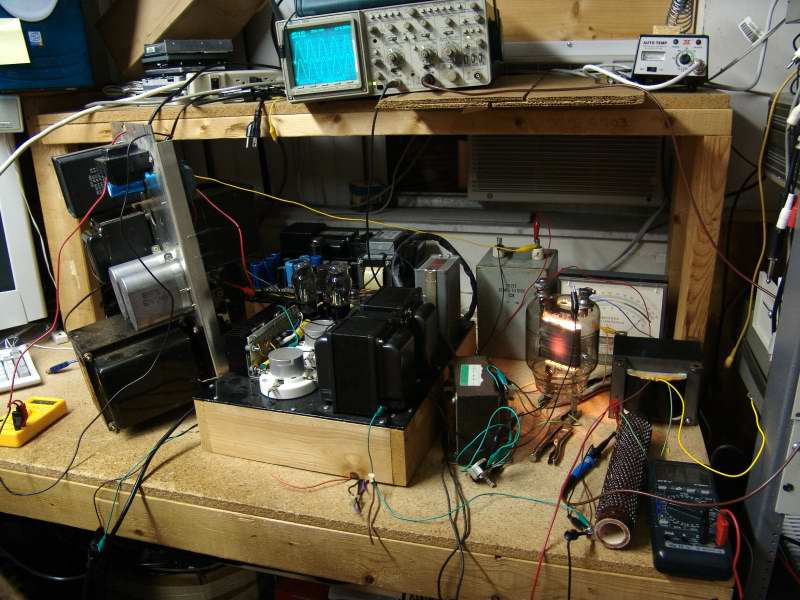
833SE amplifier prototype on a workbench
A DIY 833SE amplifier prototype during testing, showcasing the complexity and experimental nature of such projects

Extreme Voltages and Safety

The foremost concern is safety. 833 amplifiers operate with plate voltages that are unequivocally lethal, typically ranging from 1,000 to 3,000 volts. The capacitor banks in the power supply store enough energy to be deadly long after the power is disconnected. DIY guides are filled with stark warnings: "Please do not attempt to build one of these unless you have a reasonably good idea of what you are doing." Proper caging of high-voltage circuits, well-insulated wiring, and a deep respect for the electricity involved are non-negotiable prerequisites.

The Power Supply Conundrum

Designing a power supply for an 833 amp is a monumental task. It must not only provide stable, high-voltage DC but also deliver immense current on demand, especially for low-frequency notes. As documented in one extensive test, a power supply designed for a radio transmitter proved inadequate for audio, struggling to deliver power at frequencies below 50 Hz and causing breakers to trip. A robust, well-filtered power supply with large capacitors is essential for achieving the deep bass the 833 is capable of.

Taming the Filament Hum

The 833A';s filament is another significant challenge. It requires a massive 10 volts at 10 amperes. Powering this with AC is often a non-starter, as the powerful magnetic field generated by the filament can induce a persistent hum into the sensitive audio circuits. The consensus among builders is that a heavily filtered, high-current DC power supply is mandatory. This adds another layer of complexity and cost to the project, requiring rectifiers and large filter capacitors rated to handle the substantial current.

The Pinnacle of High-End: Commercial Masterpieces

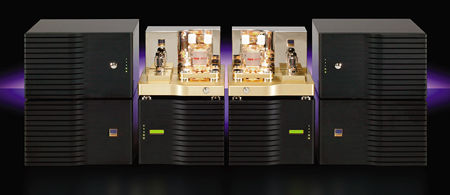
While the 833 is a favorite of ambitious DIYers, it has also been the centerpiece of some of the most extravagant commercial amplifiers ever made. The most famous is undoubtedly the Wavac SH-833. Developed by the late Japanese audio guru Nobu Shishido, these monoblock amplifiers were a statement product with a staggering price tag of $350,000 per pair upon their release.

The SH-833 claimed an output of 150 watts in pure Class-A, an extraordinary figure for a SET amplifier. It utilized a unique Inverted Interstage Transformer Coupling (IITC) circuit to drive the massive 833 tube, a design choice intended to deliver ";clear and full bass sound." The Wavac amplifiers are a testament to what is possible when cost is no object, representing the absolute zenith of 833-based audio design.

The Wavac SH-833 amplifier system
The complete Wavac SH-833 system, an example of an ultra-high-end commercial amplifier built around the 833 tube

Conclusion: An Enduring Legacy in Sound

The 833 tube amplifier is not for everyone. It is an outlier, an extremist's choice in a hobby that already has its share of esoteric pursuits. It demands a rare combination of technical expertise, unwavering attention to safety, and a significant financial and spatial investment. Yet, for those who successfully tame this beast, the rewards are said to be unparalleled.

The 833 represents more than just a component; it embodies a philosophy—a relentless pursuit of sonic authority and realism, pushing the boundaries of what vacuum tube technology can achieve. Whether in a meticulously crafted DIY project or a cost-no-object commercial masterpiece, the 833 amplifier stands as a powerful, glowing monument to the enduring magic of high-fidelity audio.

Published by IWISTAO