DIY 4-Inch Full-Range Transmission Line Speaker: A Complete Build Guide
PUBLISHED BY IWSITAO · DIY Audio · Speaker Building
How to build a back-folded labyrinth enclosure for a Markaudio 4-inch driver — a complete materials breakdown, step-by-step build guidance, hands-on audiophile optimization practices, and technically validated performance parameters from real listening sessions.
Why a Transmission Line (Labyrinth) Enclosure?
A transmission line (TL) enclosure — often called a labyrinth box in the DIY community — uses a long, folded internal pathway to extend the effective length of the speaker's rear radiation. The goal is to allow low-frequency energy to cancel itself out at the port, effectively extending bass response far beyond what a sealed or bass-reflex box of the same size can achieve.
For a 4-inch full-range driver, the advantage is particularly compelling. A typical 4-inch driver on its own struggles to produce meaningful output below 70–80Hz. Paired with a well-designed TL enclosure, the same driver can deliver bass response that rivals a 6.5-inch or even larger woofer. The trade-off is construction complexity: a TL box requires multiple internal baffles, precise path-length calculation, and careful damping.
"The labyrinth box can make up for the lack of low-frequency extension in a full-range driver. A 4-inch unit in a TL enclosure is enough to rival the low-frequency volume of a 6.5-inch or even larger woofer."
Driver Choice: Markaudio 4-Inch Full-Range
The loudspeaker driver featured in this build is a Markaudio 4-inch full-range unit. The specific model referenced in the original Chinese build log is referred to as the "Mark 4-inch full-range" — this aligns most closely with the Markaudio CHR-70 or MAOP-5 series, both well-regarded in the full-range DIY community for their low distortion and smooth off-axis response.
Each driver ships with two sealing gaskets and eight hex-head mounting screws. The gasket is essential: full-range drivers are sensitive to rear-chamber leakage, and a poor seal will damage both bass extension and midrange clarity.

Figure 1: Markaudio 4-inch full-range driver, gasket, and hex-head mounting screws
Enclosure Design Parameters
The following table summarises the key specifications of the finished enclosure. These dimensions are optimised for a 4-inch full-range driver with an Fs (resonant frequency) in the 60–80Hz range.
| Parameter | Value |
|---|---|
| Enclosure type | Back-folded labyrinth (transmission line) |
| External dimensions (W × H × D) | 480 × 280 × 198 mm |
| Panel material | 18 mm medium-density fibreboard (MDF) |
| Number of panels per enclosure | 11 pieces |
| Finished weight (per enclosure, with driver) | 17.5 kg |
| Driver size | 4 inches, full-range |
| Internal path | Folded labyrinth, smooth internal curves |
| Port exit | Rear or bottom (design-dependent) |
A key design consideration: the internal path length of a TL enclosure should approximate one-quarter wavelength of the target cutoff frequency. For a 50Hz target, the path is roughly 1.7 metres. The folded labyrinth within a 480mm-tall cabinet achieves this through multiple internal baffles that create a zigzag path. The internal structure of the enclosure is shown below. It is CNC-machined, and the connecting tabs are carefully removed using a fine saw blade.

Figure 2: Internal labyrinth structure — 11 MDF panels form the folded transmission line path
Tools and Materials
Materials
- Driver unit: Markaudio (or equivalent) 4-inch full-range × 2
- Panels: 18mm MDF, cut into 11 pieces per enclosure
- Adhesive: Yellow wood glue (PVA-based), full-cure time 20+ hours
- Sealing gaskets: Included with driver (use both)
- Mounting hardware: Hex-head screws × 8 per driver
- Finishing: Primer, black paint (mysterious black), wood filler (atom ash), putty
- Veneer: Black wood-grain vinyl sheet for final finish
Tools
- Hand saw (for panel cutting)
- Sandpaper and sanding block
- F-clamps (essential for glue-up)
- Paint brushes / spray equipment
- Router or mill (for secondary shaping — access to a friend's mould factory recommended)
- Hex key (for driver mounting)
Step-by-Step Build Log
Step 1: Panel Layout and Cutting
Begin by drawing the full panel layout, including internal baffles. The labyrinth path must be planned before any cutting: each internal baffle defines a segment of the folded pathway, and an error here cannot be corrected later. Cut the panels with a hand saw, then dry-fit all pieces to verify alignment before any glue is applied.
"First, draw the speaker's dimension drawing, including the internal structure. The labyrinth speaker design needs enough folded paths to let sound stay inside the box longer — and also pay attention to the vent position, don't make it fully sealed."
Step 2: Glue-Up (The Long Part)
Apply yellow wood glue to each joint. The glue requires more than 20 hours to fully cure; use F-clamps to apply even pressure across every joint. Insert fixing bolts before the glue skins over. Align each panel carefully — a misaligned baffle will create an air leak or a rattle.
Expect the glue-up phase to be the most time-consuming part of the entire build. The gluing process is extremely troublesome, and it takes a long time... the sweat and tears are too many to count.
Front baffle, tools(Saw blades, grinding wheels, brushes, fastening clamps, etc.), and glue; assembly process, adhesive bonding, and clamping as photos showed below.

Figure 3: Glue-up in progress — F-clamps apply even pressure while the adhesive cures
Step 3: Curing (2–3 Days)
After the main glue-up, leave the enclosure untouched for at least 48–72 hours. The yellow wood glue achieves full strength only after complete curing. Do not rush this stage. The internal labyrinth structure should be fully formed after this period.
Step 4: Secondary Machining (Milling)
After curing, the raw enclosure will show visible seams and surface irregularities. Begin by leveling the surfaces with a grinding wheel, then proceed with coarse sanding to remove major imperfections.

Step 5: Sanding and Body Work
Sand the milled surfaces starting with 80-grit, progressing to 220-grit. Apply wood filler (atom ash) to any voids or seams, then sand smooth again.
Tip: Do the sanding in the evening or in an air-conditioned space. High heat accelerates the evaporation of solvents in the filler, making it difficult to work with.
Step 6: Priming and Painting
Apply primer, sand it smooth, then apply the topcoat. The original build used a "mysterious black" (deep black) finish. Two thin coats are better than one thick coat — patience here pays off in a glass-smooth surface.

Figure 4: After painting — the "mysterious black" finish gives a high-end, understated look
Step 7: Veneer / Vinyl Wrap
The final exterior step is applying a wood-grain vinyl sheet (or veneer with lacquer). This not only improves appearance but also adds a small amount of additional damping to the cabinet walls. White turned black... mysterious black, high-end, atmospheric, classy — wildly cool and explosive!

Step 8: Driver Mounting
Install the sealing gasket on the driver, then mount it to the front baffle using the eight hex-head screws. Tighten in a cross pattern to ensure even pressure. Connect speaker wire to the terminals, respecting polarity (+ to +, − to −).
Step 9: Listen
Connect to your amplifier and listen. A properly built TL enclosure with a good full-range driver will reward you with extended, articulate bass and a coherent midrange that multi-way speakers struggle to match.

Figure 5: The completed pair — 17.5 kg each, in "mysterious black"
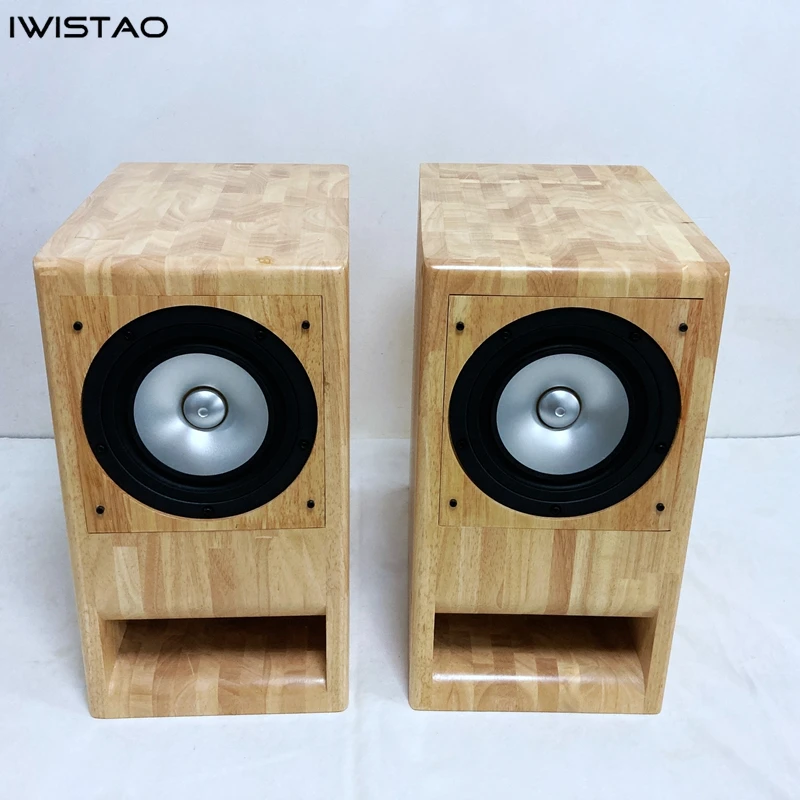
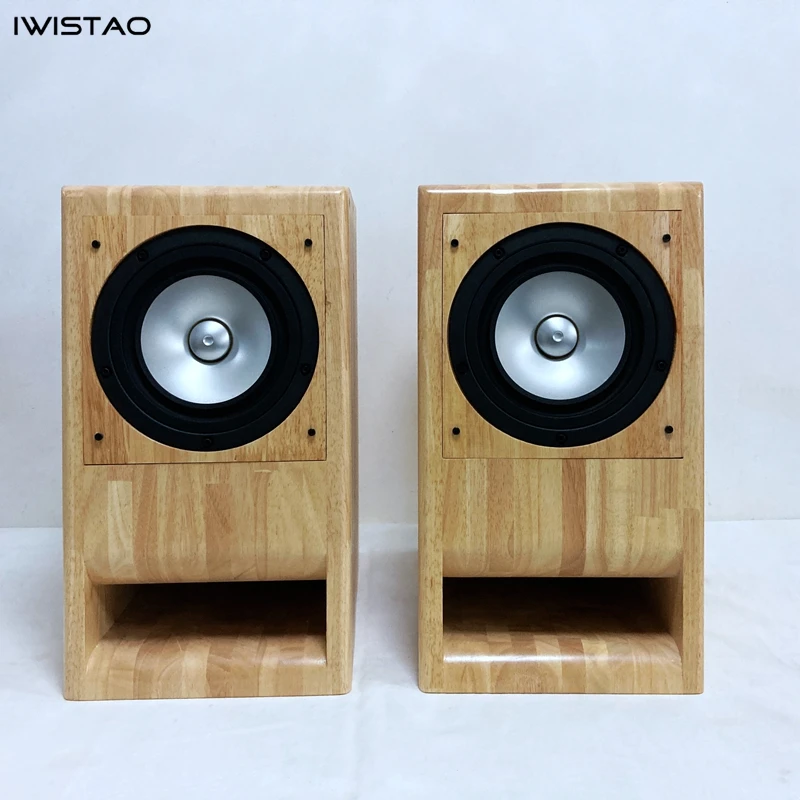
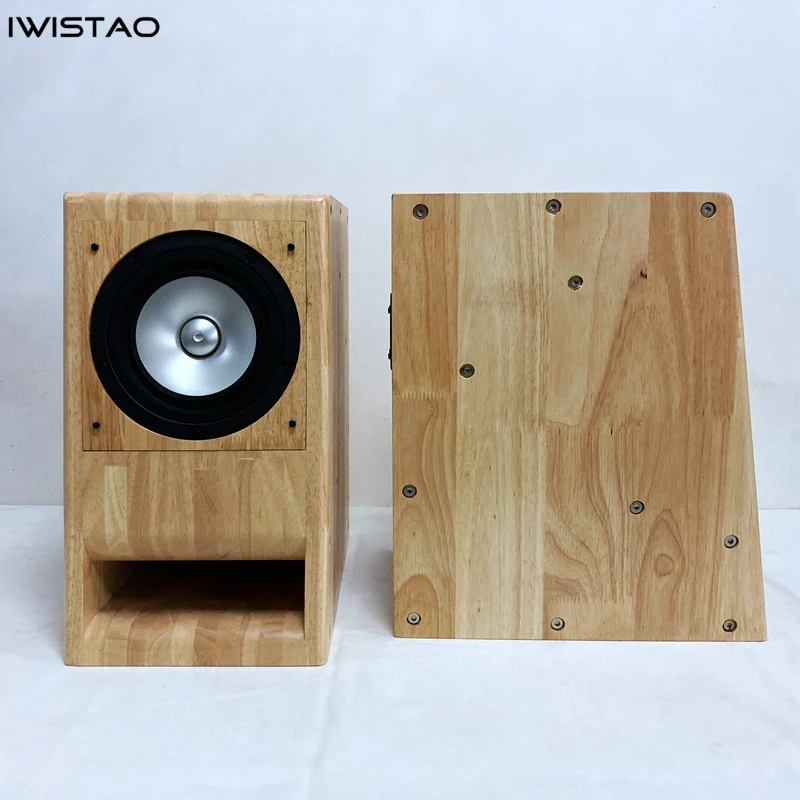
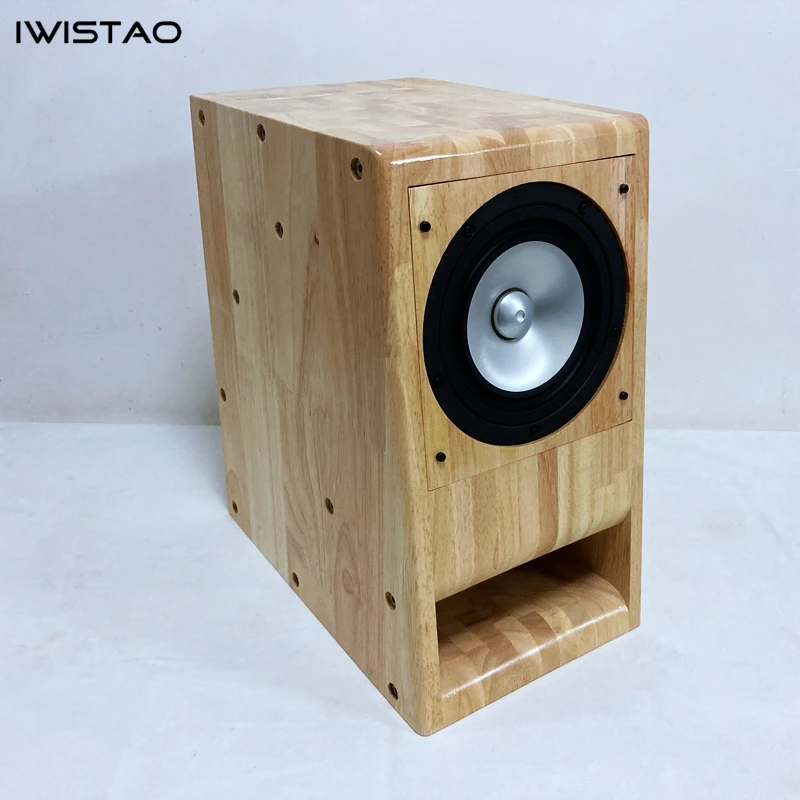
If you’d rather not go through the entire process of building a pair of transmission line speakers from scratch, you can choose IWISTAO’s ready-made solutions.IWISTAO offers transmission line speaker kits and pre-built empty cabinets ranging from 2 to 10 inches, giving audio enthusiasts flexible options to suit their needs. If you enjoy hands-on DIY projects and have some woodworking skills, you can choose the kit version. If you prefer a hassle-free solution, you can go for the finished empty cabinets instead. More details, please click the photo directly, it is just one of labyrinth speaker enclosres.

Technical Notes on Transmission Line Design
Several design parameters determine whether a TL enclosure performs well or merely looks interesting:
- Line length: Should be approximately 1/4 wavelength of the target −3dB frequency. For a 50Hz target: ~1.7m. Damping materials (fibreglass, wool, or bonded acetate fibre) reduce the effective speed of sound, effectively lengthening the line.
- Cross-sectional area: The line CSA should match or slightly exceed the driver's Sd (effective piston area). Too narrow causes compression; too wide causes midrange ripple.
- Damping: The internal path must be damped, but not over-damped. The goal is to absorb the driver's rear radiation above the tuning frequency while allowing the tuned low-frequency energy to reach the port.
- Stuffing density: Start with light damping at the driver end, increasing toward the port. This creates a progressive taper that reduces standing waves.
For a Markaudio CHR-70 in a 480mm-tall cabinet, a reasonable starting point for simulation is a 1.5–1.8m effective line length with 10–20% damping density. Use Martin King's LTSPICE models or MabJS TL calculator to refine the design before cutting wood.
Common Pitfalls
- Air leaks: Every internal joint must be fully sealed. A small leak will short-circuit the TL path and destroy low-frequency extension. Use yellow glue generously and clamp well.
- Insufficient clamping: F-clamps are not optional. The original builder used multiple clamps on every joint. Insufficient clamping leads to weak joints that vibrate.
- Rushing the glue cure: Yellow wood glue reaches "handle strength" in 30 minutes but full strength in 20+ hours. Do not handle the enclosure during the first 48 hours.
- Over-damping: Too much stuffing will kill the bass entirely. Start light; add damping if the midrange sounds "honky" or if there is a resonant peak in the upper bass.
- High-temperature work: If working in summer heat (>35°C), do sanding and painting in the evening. Solvent-based fillers and paints behave unpredictably in high heat.
Performance Expectations
A properly executed 4-inch full-range TL build will not produce subwoofer-level SPL. What it will deliver is articulate, tuneful bass that integrates seamlessly with the midrange and treble — no crossover-induced phase anomalies, no lobing, no confused imaging. For room-filling sound, the original builder compared the finished speakers favourably against a pair of Hi-Vi bookshelf speakers.
"After the pair of DIY Hi-Vi speakers were used for comparison, the Mark full-range driver's elegance and clarity really showed. The labyrinth box is the key."
Find More
- IWISTAO HIFI Empty Speaker Cabinet Finished Labyrinth Structure Solid Wood for Full Range
- IWISTAO HIFI 4 Inches Full Range Speaker Empty Labyrinth Oak Cabinet 1 Pair for Tube Amplifier
- Markaudio — Official Driver Specifications
- IWISTAO HIFI Speaker Empty Cabinet Kit Labyrinth 1 Pair High-density Fibreboard for 4/4.5/5 Inch Full Range Speaker Unit DIY
- Beyond the Box: My Journey into IWISTAO's Transmission Line Speakers
References
- Understanding Transmission Line Speakers: Theory, Design, and Applications. Understanding Transmission Line Speakers: Theory, Design, and Applications
- Martin King, "Transmission Line Performance", Quarter-Wave. https://www.quarter-wave.com/TL/TL_Performance.html
- Markaudio CHR-70 driver specifications, Markaudio Official. https://www.markaudio.com/
- Jim Griffin, "Transmission Line Design", audioXpress, 2005.
- V. Dickason, "Loudspeaker Design Cookbook", 7th Edition, 2006 — Chapter 7: Enclosure Design (Transmission Line).